Tile Roof Replacement in Monterey Park from $8,000. The tile is almost always reusable. What has failed is underneath it, and on a tight lot the cost is in the handling. Free inspection and a written quote.
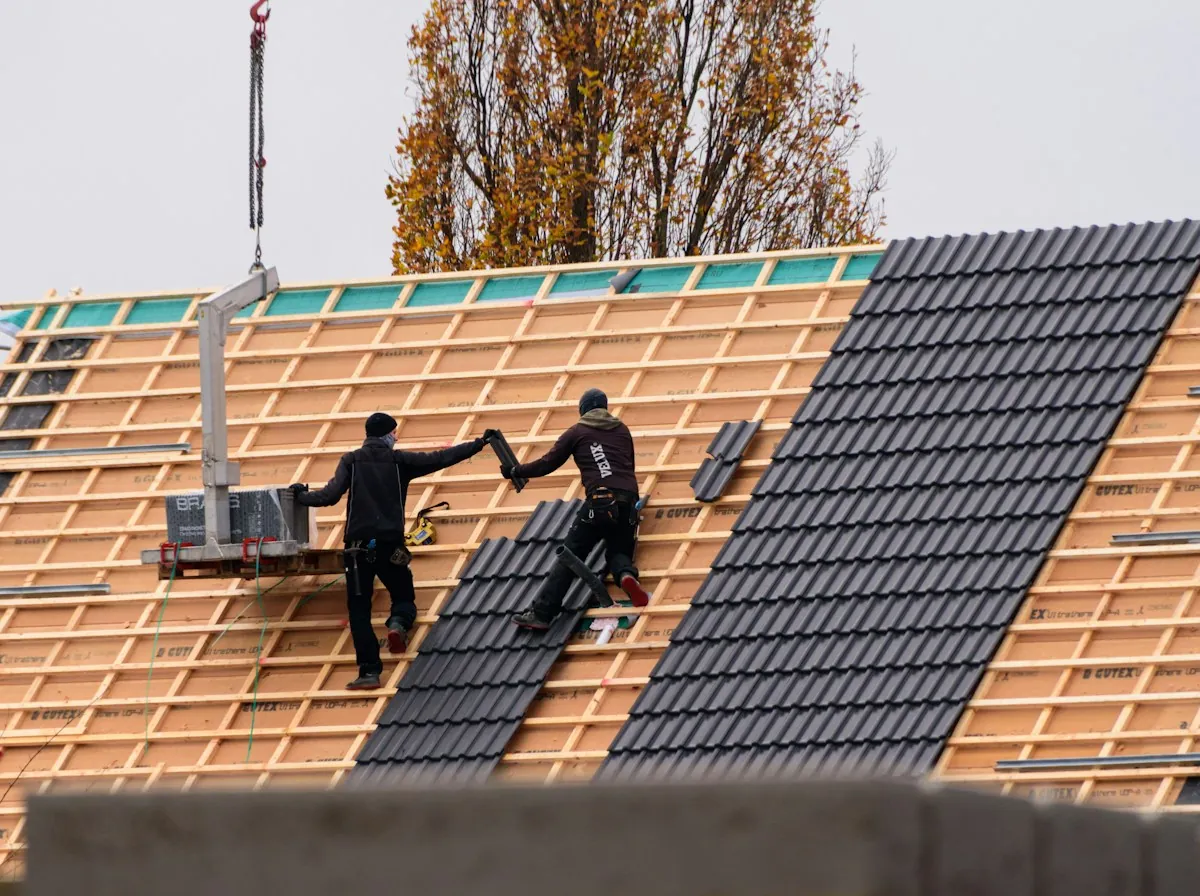
Handling tile on a sloping lot is slower and breakage runs higher, because every piece is carried up and down a gradient twice on a relay. Expect that in the allowance, stated up front rather than arriving as a variation partway through.
Concrete tile outlives the underlayment beneath it by decades. A tile field that looks perfectly sound from the street can be sitting on felt that has gone brittle and torn, which is why these roofs leak with no broken tile anywhere near the stain.


This is the lane where most people are quoted the wrong job. Buying new tile is $15 to $25 per square foot in Los Angeles, so $30,000 to $60,000 for a full replacement. A lift and relay -- your tile off, new underlayment down, the same tile back -- is $8,000 to $22,000, because the tile is not bought twice. On most valley roofs the tile has decades left and only the felt beneath it has gone. Expect the upper end of every range. Access and staging on a hillside lot add labor, steeper pitch adds more, and split-level geometry adds valleys -- each of which is waste and time. A price quoted purely on roof area will be wrong here.
One to three dollars per square foot. Everything else is the labor of lifting, stacking and relaying tile without breaking it -- which is why staging space shows up in the price.
Nowhere to stack the tile, so the roof gets worked in sections instead of stripped in one pass. A discontinued profile, where every breakage is a tile that cannot be replaced. A sloping lot, where every piece is carried up a gradient.
Widespread cracking, spalling concrete, or a profile so brittle that half of it will not survive being lifted. We will tell you when a relay is not viable -- but that is the minority, and it should be shown to you, not asserted.
The gradient changes the job rather than the roof. Staging, material handling and getting a tear-off off a sloping lot are all slower, and building into a hill produces split levels joined by short low-slope links -- which are exactly where the water gets in, because there is never enough fall in a run that short.
Worth knowing before you start ringing round, and worth building into anything that has a date attached to it.
Roofs here fail quietly through a long dry summer -- heat and ultraviolet working on the covering, granules washing into the gutter, laps loosening -- and then leak all at once in the first serious storm of the winter. Every roofer in the San Gabriel Valley takes those calls on the same three nights, which is why a replacement booked in September costs less and starts sooner than the identical job booked in February.
Building into a hill produces split levels joined by short low-slope links, and those links are where the trouble is: the run is too short to get real fall into, so water leaves slowly and the junction with the pitched roof above takes the load.
On a sloping lot a garage is frequently built into the hill with one wall below grade, and that changes the damp diagnosis completely.
Steeper pitch on hillside houses changes the arithmetic: labor goes up because the roof needs staging a walkable pitch does not, and waste rises with the valley count on split-level geometry.
Split-level houses are joined by short low-slope links between the levels, and those are the defining Monterey Park low-slope problem.
Split levels give Monterey Park something flat streets do not: genuine natural partial boundaries.
Oldest settlement in the valley. Rarely one roof.
A different city, with a different department.
Room to work, which makes a tile relay cheaper.
Same stock, more space, its own conversion rules.
Mature canopy. Debris in every valley.
Old stock and skip sheathing. Check the deck.
Small apartment blocks and the logistics they bring.
The questions this job turns on, answered up front.
It may be the right price for the wrong job. Full replacement in Los Angeles is $15 to $25 per square foot, so $30,000 to $60,000 is normal for one. But most valley tile roofs need a lift and relay instead -- $8,000 to $22,000 -- because your existing tile goes back down and only the underlayment is new.
Most concrete profiles from the 1970s onward do, with an allowance for breakage that we state up front rather than adding later. What decides it is the profile and the handling: a tight lot means working in sections and more movement per tile, and a sloping lot means carrying every piece up a gradient twice.
Two to four days per structure once it starts: tear-off and dry-in on day one, covering after. Tile takes longer than composition, and a sectional relay on a tight lot longer again. Weather moves it, and we will not dry-in a roof we cannot finish.
No. The inspection is free, it covers every structure on the parcel rather than the one you rang about, the written quote is free, and neither carries an obligation. What we will not do is give you a number at the curb without going up.
In this city the commonest reason is that they are not counting the same structures -- one included the detached garage and the addition, the other priced the house. After that it is a tear-off versus an overlay, and how sheathing replacement is priced. Ask both for the price itemized by structure and the difference usually explains itself.
Free inspection -- house, garage, addition and patio cover, not just the one. A written quote against a written scope, itemized by structure.