Tile Roof Replacement in Temple City from $8,000. The tile is almost always reusable. What has failed is underneath it, and on a tight lot the cost is in the handling. Free inspection and a written quote.
Canopy debris is what kills tile roofs here. Leaf litter washes into the courses and sits on the underlayment, holding damp against it long after rain stops, so the felt rots while the tile above still looks new. Clearing under the courses is part of the assessment rather than something done afterwards.
Concrete tile outlives the underlayment beneath it by decades. A tile field that looks perfectly sound from the street can be sitting on felt that has gone brittle and torn, which is why these roofs leak with no broken tile anywhere near the stain.


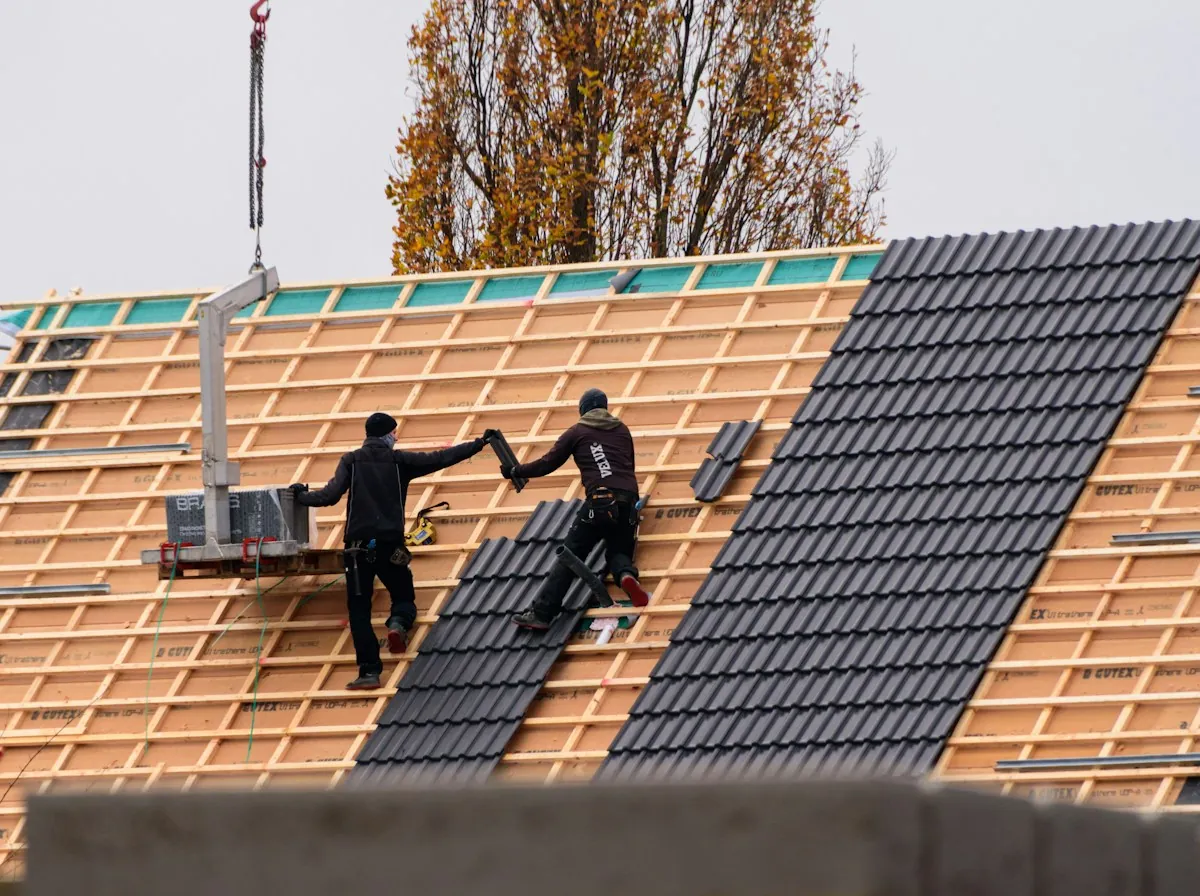
This is the lane where most people are quoted the wrong job. Buying new tile is $15 to $25 per square foot in Los Angeles, so $30,000 to $60,000 for a full replacement. A lift and relay -- your tile off, new underlayment down, the same tile back -- is $8,000 to $22,000, because the tile is not bought twice. On most valley roofs the tile has decades left and only the felt beneath it has gone. Under this canopy two lines belong on the quote that would not appear elsewhere: protecting or trimming limbs before a tear-off, and enough gutter and outlet capacity for the actual leaf load. Neither is padding, and both are cheaper than the roof they save.
One to three dollars per square foot. Everything else is the labor of lifting, stacking and relaying tile without breaking it -- which is why staging space shows up in the price.
Nowhere to stack the tile, so the roof gets worked in sections instead of stripped in one pass. A discontinued profile, where every breakage is a tile that cannot be replaced. A sloping lot, where every piece is carried up a gradient.
Widespread cracking, spalling concrete, or a profile so brittle that half of it will not survive being lifted. We will tell you when a relay is not viable -- but that is the minority, and it should be shown to you, not asserted.
The canopy is the roofing story here in a way it is not further south. Mature street trees mean leaf litter in valleys and gutters holding water against the covering after rain, limbs abrading the surface in wind, and shaded slopes that never fully dry -- all of which age a roof on a different schedule from the sunlit side of the same house.
On most parcels here there is more than one answer, and the expensive mistake is replacing the wrong one.
House, detached garage, rear addition, patio cover. Four roofs of four different ages, and a single figure on a quote quietly decides which of them it covers. Ask for it itemized and two quotes become comparable for the first time.
A tile roof quoted at $30,000 to $60,000 for replacement is very often an $8,000 to $22,000 lift and relay, because the tile is fine and only the felt beneath it has failed.
In a converted garage, damp that is worse in dry weather is condensation, not a leak -- a room built under a roof that was never insulated or ventilated. Replacing that roof without fixing that is money spent on the wrong problem.
Tree work is a real line on a Temple City quote and it is not padding.
Under a heavy canopy a converted garage has a second problem on top of the usual one.
Shade is not kind to asphalt.
Under this canopy the outlet blocks, and once it blocks a flat roof becomes a shallow pool.
The shaded slope fails first under this canopy, reliably, so a single-slope partial is often technically correct here.
Oldest settlement in the valley. Rarely one roof.
A different city, with a different department.
Room to work, which makes a tile relay cheaper.
Same stock, more space, its own conversion rules.
Old stock and skip sheathing. Check the deck.
Hillside split levels and short low-slope links.
Small apartment blocks and the logistics they bring.
The questions this job turns on, answered up front.
It may be the right price for the wrong job. Full replacement in Los Angeles is $15 to $25 per square foot, so $30,000 to $60,000 is normal for one. But most valley tile roofs need a lift and relay instead -- $8,000 to $22,000 -- because your existing tile goes back down and only the underlayment is new.
Most concrete profiles from the 1970s onward do, with an allowance for breakage that we state up front rather than adding later. What decides it is the profile and the handling: a tight lot means working in sections and more movement per tile, and a sloping lot means carrying every piece up a gradient twice.
Re-roofing is permitted work and we pull it. Which city matters more here than almost anywhere: El Monte and South El Monte are separate incorporated cities with separate building departments, and an application on the wrong desk costs a week. The inspection that comes with the permit is your independent check that the specification you paid for is what went on.
Not on a pitched roof here. The steep-slope cool-roof requirement applies in Title 24 climate zones 10 to 15, and El Monte is in zone 9. Low slope is different -- an aged SRI of 75 applies in all sixteen zones once you replace 50% or more of the roof area in a rolling year. Anyone telling you a pitched El Monte roof must be a cool roof is quoting the wrong zone.
No. The inspection is free, it covers every structure on the parcel rather than the one you rang about, the written quote is free, and neither carries an obligation. What we will not do is give you a number at the curb without going up.
Free inspection -- house, garage, addition and patio cover, not just the one. A written quote against a written scope, itemized by structure.